
More examples
Freidel Craft reaction of Toluene with Benzyl bromide in the presence of GaBr3.

In the initial stages of the reaction (0.01 sec) the o- and p- products predominate because the pathway that leads to them has lower enrgy barier. After ten seconds the major product is the one through meta substitution.
In the initial stages the major product is the one, which is formed faster, and later after sufficient time elapses equilibrium conditions are established and the reaction is driven in the direction of the more stable product.
Thus the reaction is under kinetic control in the initial stages but under thermodynamic control later.PS: The product proportion in the initial stages has significant amount of meta isomer, hence the reaction cannot be considered at that time as under complete kinetic control.
Electrophilic addition to conjugated dienes
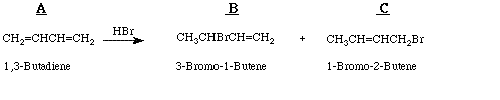
Addition of HBr to a conjugated diene like 1,3-Butadiene results in two products. The 1,2-substitution product that is 3-Bromo-1-butene and the 1,4-substitution product, that is, 1-Bromo-2-butene.
At lower temperatures the major product is through 1,2 addition. At higher temperatures it is the 1,4 addition product that predominates.
At higher temperatures equilibrium conditions are established and the reaction is driven towards the more stable product.
The more substituted alkene is thermodynamically more stable alkene.
The more stable alkene is associated with less heat of hydrogenation

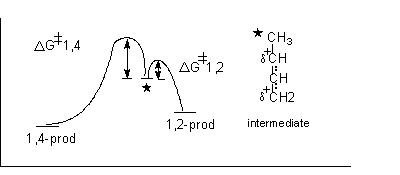
Features with respect to the energy profile shown.
- The free energy of activation leading to 1,2-product is less than for 1,4-product.
- At low temperatures the intermediate ion has sufficient energy to cross the energy barrier leading to 1,2-product. Only some ions have enough energy to overcome a similar barrier leading to 1,4-product.
- In either case the product formation is irreversible since sufficient energy is not available to lift the product from the deep potential energy valley.
- At higher temperatures there is sufficient energy to overcome both barriers.
- More importantly both reactions are reversible.
- The 1,2-product is still formed faster but being less stable reverts back to the intermediate faster.
- The 1,4- product formed being more stable reverts back to the intermediate slowly. Thus making the more stable compound as the predominate product.
- The reaction is therefore governed by thermodynamic control.
Enolate anion: use of a strong base
Ketones that have a hydrogen atoms (atoms attached to the carbon, adjacent to the carbonyl group) on either side of the carbonyl group can result in two different anions in the presence of a strong base.
The anion with the more substituted double bond is thermodynamically more stable; if it is the major product then the reaction is under thermodynamic control.
If the anion with less substituted double bond is the major product then the reaction is under kinetic control.

If, [A] / [B] = ka / kb where ka& kb are the rate constants for the formation of A and B,
Then the reaction is under kinetic control.
If, [A] / [B] = K where K is the equilibrium constant for the reversible conversion of A and B, then the reaction is under thermodynamic control.
Ideal conditions for kinetic control are in which deprotonation is rapid, quantitative and irreversible.
This is made possible by using LDA (Lithium diisopropyl amide) in aprotic solvent in the absence of excess of ketone.
Protic solvent permit equilibrium, leading to reversible deprotonation and hence thermodynamic control becomes predominate.
Use of LDA leads to kinetically controlled product.
When excess ketone is present after the base is used up a second reaction can occur leading to equilibrium conditions and therefore thermodynamic control.