
Let us examine the energy profile of a chemical reaction.
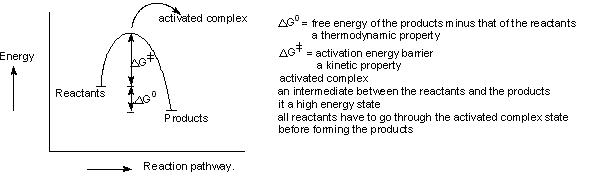
- A reaction is thermodynamically spontaneous if the free energy change is negative(products are associated with less energy).
- A reaction, which has a high activation energy barrier, is a slow reaction, and with a low energy barrier is a fast reaction.
- Thus for a chemical reaction to occur it is not enough that it has favourable thermodynamics it should also have favourable kinetics.
An example
The following data is associated with the reaction
The equilibrium constant K = 1016 ΔGo = -22Kcal / mol. ΔHo = -18 Kcal / mol, ΔSo = +13 Cal-1deg-1
a) The driving force is large, that is, it has a large equilibrium constant, a large negative free energy change and a favourable entropy change
b) The C-O bond is stronger than C-Cl bond.
Yet 0 .05M solution of CH3Cl mixed with 0.1M NaOH, the reaction is not even 10% complete in two days at room temperature.
This is because the reaction has favourable thermodynamics but the activation energy barrier is too large, unless it is overcome the reaction will not take place.
This is achieved by supplying energy by heating the reaction mixture. Increase in temperature by 100o C doubles the rate of a reaction ( This is referred to as temperature coefficient ).
It is interesting to speculate what would happen if one fine morning the height barrier for the flow of water and the energy barrier for chemical reactions disappear? Well for one thing, that morning would most definitely will not be a fine morning.
Any speculations? (mpeeran@gmail.com)