
Alkyl halides - Mechanism of nucleophilic substitution. Level 2
Some more features of mechanism of nucleophilic substitution in alkyl halides
Any factor that prevents the approach of the nucleophile to the carbon bearing the nucleofuge (leaving group) will not promote SN2 pathway.
Non polar solvent are good for SN2 reactions. But the best is a polar aprotic solvent like DMSO. The solvent selectively solvates the cation making the anion a strong nucleophile thus promoting the reaction. Crown ethers have similar influence.
If the alkyl halide can form a stable carbocation then the reaction is going to be facoured by SN1 mechanism. Tertiary halides, allylic and bezylic halides substitute this way.
If the reaction takes place at the stereo center then SN2 will lead to inversion in configuration and SN1 will result in a racemic mixture.
SN1 reactions may involve rearrangements, when there is a possibility of formation of a more stable carbocation exists.
-
A good leaving group is the one that forms a more stable anion.
Solvolysis is a reaction in which the solvent itself acts as a nucleophile.
Nucleophilic substitution of halogen in vinyl and aryl halides is very difficult. The halogen is attached to a sp2 carbon. The lone pair on the halogen is involved in delocalisation, hence the C-Cl bond is strong.
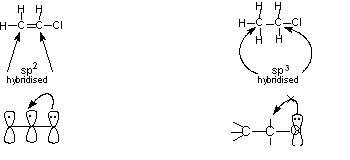
The lone pair from chlorine atom is delocalised, since the adjacent atom has a p-orbital.
The C-Cl.bond is stronger, hence nucleophilic substitution is difficult.
No delocalisation of the lone pair since there is no p-orbital pathway.
The C-Cl bond is of normal strength, hence nucleophilic substitution is possible