
Alkyl halides - Mechanism of nucleophilic substitution. Level I
- Alkyl halides are mono-halogen substituted alkanes.
- They have an alkyl group bonded to a halogen atom.
- Examples: Bromoethane, 1-Chloropropane, 2-Chloropropane,
- Synthesis: by addition of a hydrogen halide to an alkene or by substitution of the –OH group in an alcohol using PCl5, SOCl2 or PBr3
- Properties: Alkyl halides are saturated molecules and will therefore undergo only substitution reactions. The C-halogen bond is polarised due to the higher electronegativity of halogen, the halogen atom acquires a little excess electron density while the carbon becomes electron deficient and constitutes an electrophilic centre. Any reagent that is nucleophilic in nature will seek this electron deficient carbon and form a bond resulting in substitution of halogen. Thus many reactions of alkyl halides are nucleophilic substitution reactions.
- Use of alcoholic KOH or NaOEt/EtOH, will result in elimination(dehydrohalogenation). Elimination converts an alkyl halide into an alkene.
- Elimination reaction is opposite of an addition reaction.
- In this reaction a halogen atom is lost from one carbon and hydrogen at the next carbon.
Mechanism of nucleophilic substitution
reactions. The SN1 and SN2 mechanisms.

- Reaction mechanism is the sequence of events (bond breaking and formation) that take place at the molecular level in a reaction and the energetics involved in the process.
- In the above example only two events have happened, a carbon halogen bond has broken and a carbon oxygen bond has formed.
- This could have happened in two possible ways.
- Bond breaking first and bond formation next.
- Bond formation and breaking simultaneously
- The third possibility is bond formation first which would result in carbon having five bonds and that is not possible
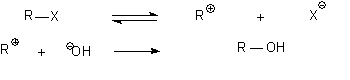
- Bond breaking first will result in a carbocation intermediate which in the second step will react with the nucleophile(base) forming the product.
- The first step is slow and reversible; the overall rate depends on this step.
- Since only the alkyl halide is involved in this step it is unimolecular. Hence it is termed Substitution Nucleophilic unimolecular ( SN1).
- The rate of the reaction depends on only the alkyl halide and not on the base.
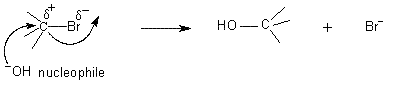
If bond breaking and bond formation is simultaneous, the reaction takes place in a single step and the same is the rate determining step.
- Since both alkyl halide and nucleophile(base) are involved in this step it is bimolecular and of second order. Hence it is termed Substitution Nucleophilic Bimolecular ( SN2).
- In this process there is no intermediate involved. The reaction proceeds through a transition state wherein both the nucleophile and the leaving group are loosely bonded to the central carbon.
- The rate of the reaction depends on both the alkyl halide and the base.
SN1
SN2
1
Number of steps
two
one
2
Rate
r œ [alkyl halide]
r œ [alkyl halide][base]
3
Favourable Solvent
polar
non polar
4
Structure
tertiary halides substitute through SN1
primary halides substitute through SN2
Copyrights: 2005 www.chemvista.org All Rights Reserved