
Affinity Chromatography
ByAfter activation it can be derivatised by a large number of different groups creating different immobilised ligands on the matrix. The following scheme illustrates this feature.
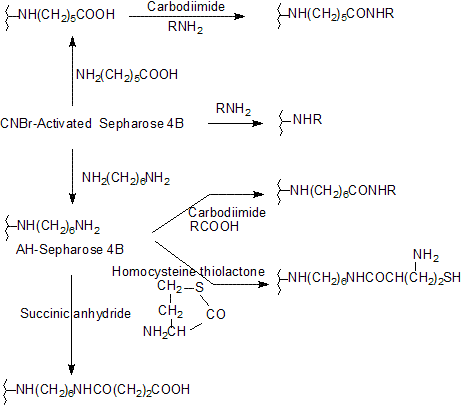
The ligand selected, depends on the substance to be purified.
The conditions used while attaching the ligand and later while elution should be mild and should not damage either the solid support, the ligand itself, or denature the component being separated.
The coupled gel must be washed thoroughly. Most importantly there must be an accurate assay system available for the ligand to find out how much of the material is bound to the ligand.
An example: The -NH2 groups on the beads may be detected very easily by the conventional diazotisation test.
For quantitative estimation the following method is used.
A known amount of the dye which binds to he amino groups (picryl sulphamic acid) is added to a known amount of the beads. Some dye binds and the excess unreacted dye is estimated through absorbance measurement(540 nm). Thus the capacity of the beads is expressed in terms of the number of millimoles of the dye that is bound.