
Home | Sitemap | Contact Us

Affinity Chromatography

By
Dr. Mehboob Peeran

Introduction

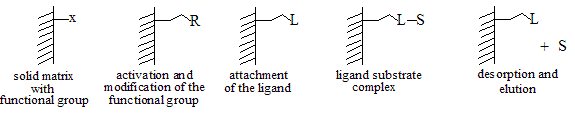
Affinity chromatography is a type of adsorption chromatography. In this method the stationary phase or the bed material in the column has biological affinity for the substance to be isolated. The specific properties of the stationary phase are developed by covalently linking an appropriate binding ligand to an insoluble porous support (solid matrix), thus immobilising one of the components of the interacting systems on the solid matrix. The mixture, which contains the specific substance to be separated, is then made to pass through the solid matrix when the ligand, which has specific affinity to the component to be, separated binds selectively to it. The resulting complex is then washed to get rid of other undesirable substances and eluted with a solvent system which breaks up the forces that bind the ligand and the component (desorption), thus making elution of the particular component possible.

These basic steps are illustrated in the following scheme.

affinity1

The word affinity refers to the nature of interaction between the immobilised ligand on the polymer support and another substance, which selectively binds to the ligand. He nature of the affinity can be of different types, basically it is:

  • Electrostatic interaction
  • Covalent interactions
  • Biospecific interactions.

Among these, the biospecific interactions are highly specific and can be used in separations of a particular substance in a mixture of several dozens or even hundreds of others. Some of these include:

  • Antigen-Antibody interactions
  • Lectin-Carbohydrate interactions
  • Enzyme-Inhibitor interactions
  • Harmone-Receptor interactions
  • IgG-Protein interaction.

Biologically active molecules that have been purified by this technique include enzymes, antibodies, nucleic acids, vitamin or co-factor binding proteins, hormones or drug receptors, sulphahydril group containing proteins and so on.