
Complexes with Urea
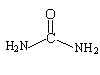
Urea forms complexes with metal ions like Fe3+, Cr3+, Zn2+, Cu2+, Pt, Pd. Co-ordination can occur through oxygen or nitrogen atom and changes in stretching frequency of the carbonyl group follows the same trends as in N,N-Dimethylacetamide with no appreciable changes in the N-H frequency( vN-H = 3500, 3350; in the complex the vibration is observed around 3300 cm-1). The vibrational frequency of C-N bond increases considerably. These changes can be rationalised through the resonance structures of urea, which are shown below.
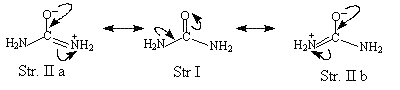
i) When coordination occurs through oxygen, there is a decrease in the C-O stretching frequency due to major contribution of structures II a and II b, simultaneously there is an increase in the absorption due to C-N. No appreciable changes in N-H stretching .
ii) When co-ordination occurs through nitrogen reverse is observed, that is there is an increase in C-O and a decrease in that of C-N stretching frequencies. The increase is attributed to Structure I, which is the only contributor (both nitrogen atoms are involved in complexation). The values can be seen in the following table.