
Sigmatropic Rearrangements
- Sigmatropic reactions are a type of pericyclic reactions which take place through a cyclic transition state.
- They are generally not influenced by solvent or a catalyst.
- They take place through thermal or photochemical initiation.
- A sigmatropic rearrangement involves the migration of a sigma bond next to a Pi system to a new position in the molecule.
- It is an intramolecular process. The pi system gets rearranged in the process.
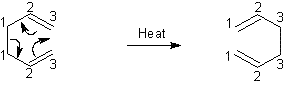
- In the above diagram, a sigma bond is broken at [1,1] and a new sigma bond is formed at [3,3]. The sigma bond migrates from [1,1] to [3,3].
- Hence the reaction istermed as a [3,3]-sigmatropic rearrangement.
- The curved arrows are useful to keep track of the change. But the reaction does not take place in that specific manner. The process takes place through a cyclic transition state.
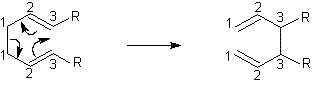
- Also though rearrangement has taken place in the equation shown, the product is indistinguishable from the reactant. Starting the reaction either using the deuteriated or substituted diene, it can be seen indeed a change has occured, as in the following examples.
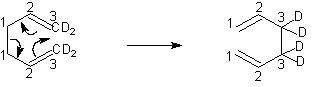
- The difference is clear from the NMR spectra of the compounds.
- The product will have the vinylic protons signal as expected in the range 3.5 to 4.5 ppm,
- This signal will not be present in the spectrum of the reactant, other fferences are also noticeable.
- Note: Deuterium is NMR active but does not appear in the proton NMR range.
- The substituted diene as shown after rearrangement gives a product, which is distinct.
Copyrights: 2005 www.chemvista.org All Rights Reserved.
Author: Rajendra Prasad