
Srinivasa K
Stereo Chemical Information from coupling constant
Distinction between cis and trans isomers Trans coupling is greater than for cis.
From the value the isomers can be identified as in the following example.
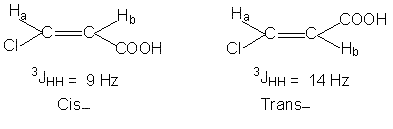
- For coupling the two hydrogens must have different chemical shift.
- Trans coupling (range :11 to 19 Hz) is greater than cis coupling (range: 5 to 14 Hz).
- 3JHH means coupling between two hydrogens separated by a distance of three bonds (vicinal coupling). If it is coupling between hydrogens at the same carbon then it is 2JHH (geminal coupling)
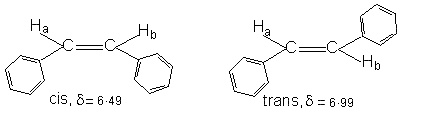
In some molecules the cis-trans, distinction is made even from the position of the absorption, as in cis and trans stilbenes. In trans case the hydrogens are deshielded by two aromatic rings while in the cis case it is by one ring.
Variation of dihedral angle with coupling constant Dihedral angle
Consider the following Newman and Sawhorse projections for ethane
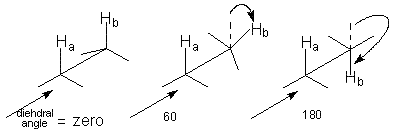
- Looking from the front Hb is eclipsed by Ha the angle between the plane containing Ha and Hb is zero (they are in the same plane).
- The second conformation has Hb at a different spatial position, they are not in the same plane. The plane containing Hb is 600 to the right of the plane containing Ha. This is the dihedral angle, in the first case the dihedral angle is zero.
- In the third case though the two atoms are in the same plane Hb has undergone a rotation of 1800 and that is the dihedral angle.
- The dihedral angle is used when two are separated by three bonds.
- Martin Karplus was the first to study the variation of coupling constant 3JHH with dihedral angle.
- The magnitude of the coupling constant between hydrogens of adjacent carbon atoms depend directly on the dihedral angle.
- This magnitude is greatest when this is zero or 1800 and smallest when it is 900.
- When it is zero side-side overlap of the two C-H bond orbitals will be maximum, when it is 1800 back lobes overlap is maximum leading to higher “J”. When it is 600 C-H bond orbitals overlap is at a minimum since they are perpendicular with each other leading to lower “J”.
Stereochemistry of cyclohexane derivatives
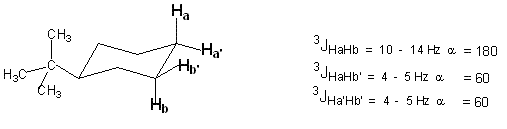
The information from the above can be used to assign the configuration of the anomeric carbon in cyclic sugars. In the case of α- glucose at the anomeric carbon the equatorial proton is has a chemical shift of δ 5.2 which is down field by 0.5 for the corresponding axial proton in β-glucose.