
Hydrogen Bonding
“Oxygen is more electro negative than hydrogen, this fact is so important that if it were not to be true, all living organisms, you and I included would not have existed. Life as we know would not have been possible.”
- Strange but true. Let us analyse this statement starting with a look at the polarity of water molecule.
- In this molecule due to the greater electronegativity of Oxygen there is a polarization of electron density towards the atom of higher electronegativity.
- This leads to a slight excess concentration of charge density on the oxygen atom and therefore the hydrogen atom becomes slightly electron deficient. This can be represented as follows.
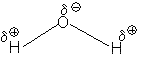
In a certain volume of water there are millions and millions of such molecules. They co-exist in a certain pattern. The negative part of one molecule will be closer to the positive part of another. This electrostatic attraction is termed “Hydrogen bonding”.
The electrostatic attraction between a hydrogen bonded to an electronegative atom and another electronegative atom
- Another way of looking at it would be as a proton embedded in the electron cloud of two other atoms A and B. ( A—H····B).
- Hydrogen bonding occurs between a proton donor group A-H and a proton acceptor group , where A is an electronegative atom such as O, N and a halogen, while the acceptor group is a lone pair of an electronegative atom.
- This attraction does not seem very significant in its magnitude, sure it is small, just about 5 to 8 KCals per mole while the regular covalent bond strength is ten times more, but its impact on the whole system is tremendous.
- Due to the greater electronegativity of Oxygen, water is a polar molecule, which in turn is the cause of existence of hydrogen bonding. The unique properties of water are due to hydrogen bonding.
- Hydrogen bonding is the reason for the high heat capacity of water. It takes a long time for water to get heated up (to a particular temperature) and an equally long time to cool down unlike for instance a metal. The heat retaining capacity of water therefore is high.
- Thus during daytime when we receive solar radiation, it is water, around three fourth of the globe that absorbs most of the heat. In the absence of this feature earth’s temperature would possibly be as high as 200oC as on the lunar surface (Moon has no water). At night times when we do not receive the solar radiation directly, it is water that releases the heat without which the night temperature would have been probably be –150oC again as on the lunar surface, which is not facing the sun.
- Water therefore acts as a moderator of temperature on this planet to within the range in which life as we know is possible.
Features of Hydrogen Bonding
Copyrights: 2005 www.chemvista.org All Rights Reserved