
Curtin-Hammett Principle
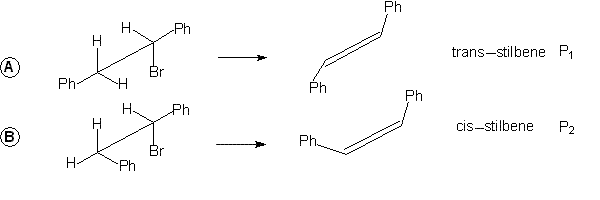
- A and B are conformational isomers.
- Under elimination conditions A leads to trans-stilbene while B leads to cis-stilbene.
- The compound exists as a mixture of the two conformational isomers A and B, among others and therefore elimination leads to a mixture of the two stereoisomers P1and P2.
- The question is which is the major product?
- Normally the more stable comformer should lead to the major product
But according to Curtin Hammett principle
“The product proportion does not depend on the ground state population of the two conformational isomers, but depends on the transition state energies of the two processes.”
- That is the more stable conformational isomer does not necessarily lead to the major product.
- The major product is the one that has less activation energy barrier.
- Conformation B has more steric problems. Due to the interactions of the two phenyl rings has a higher energy barrier and thus leads to the minor product.
- Mathematically the Principle can be explained as follows.
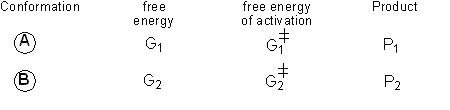

P1 / P2 is the product proportion, k1and k2 are the rate constants of the two processes and K is the equilibrium constant for the equilibrium between the two isomers. [x] is the concentration of all other species.
Copyrights: 2005 www.chemvista.org All Rights Reserved