
Annulenes
- They are monocyclic conjugated systems, that is, they have alternate double bonds in a cyclic system.
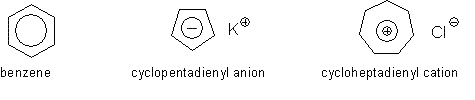
- The ring size is indicated in the name in brackets, thus benzene is [6]-annulene.
- All annulenes are not aromatic. Planar cyclic systems that have (4n+2) Pi electrons involved in cyclic delocalisation ( Huckel Rule) are aromatic and similarly the 4n systems are antiaromatic.
Importance of Annulenes
- Most of these compounds are of considerable academic importance. Of course compounds like benzene and its derivatives are of industrial importance as well, which is common knowledge.
- Before 1960 only two compounds benzene and cyclooctatetraene were known two verify Huckel observations. Subsequently a large number were synthesized and the predictions of Huckel rule were confirmed.
Two electron systems
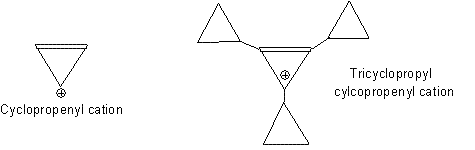
- Huckel rule predicts cyclopropenyl cation to be aromatic. It has two electrons (n=0) involved in cyclic delocalisation.
- Many stable substituted systems have been prepared. Among others the trichloro, diphenyl, and dipropyl derivatives are known.
- Tricyclopropyl cyclopropenyl cation is one among the more stable cations known.
Four electron systems
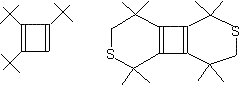
A closed loop of 4n systems is anti aromatic, less stable than the corresponding open chain counterpart. They have been studied by trapping them in solid matrices at low temperatures. Substituted cyclobutadienes of varying degrees of stability have been prepared. These molecules are relatively stable because dimerisation is sterically hindered.
Six electron systems
Copyrights: 2005 www.chemvista.org All Rights Reserved