
- It may be surprising if some one says that nitric acid can behave as a base. Yes it can under certain conditions. For instance nitric acid behaves as a base with respect to sulphuric acid in the nitration of benzene. At the same time nitric acid is a well known acid and it behaves as such in most reactions.
- The concept of acids and bases therefore is relative. A given compound is an acid with respect to another compound which is a base in a particular reaction.
- Thus water may behave as an acid in some reactions or as a base in others at the same time we consider it as neutral. In short whether a compound is an acid or a base depends on the compound with which it is reacting.
- Here are some features of acids and bases.
ACIDS : turn blue litmus red, react with a base to form salt. BASES: turn red litmus blue, react with acids to form salt.
ACID: proton donor- Example: HCl, Acetic acid.
Base: proton acceptor- Example:NaOH.
ACID: Electron pair acceptor(has an atom with a empty orbital which can accomodate a pair of electrons)AlCl3.
BASE: electron pair donor. NH3 (has an atom with an orbital which has a pair of electrons)
- In the above example HCl donates a proton and water accepts it, therefore HCl is an acid and water is a base, also HCl undergoes complete dissociation so it is a strong acid.
- H+ which is a proton is not capable of independent existence in solution, it exists in combination with a water molecule as H3O+ which is called hydronium ion or hydroxonium ion.
Weak acid: An acid which undergoes partial dissociation and exists as an equlibrium mixture of the undissociated acid and the ions produced due to partial dissociation. Most carboxylic acids are weak acids.
CH3COOH + H2O —> CH3COO- + H3O+
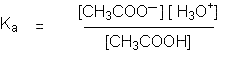
The larger the Ka greater is the dissociation of the acid hence stronger is the acid. The value of Ka is a fraction which is inconvenient for use in comparison, Ka is transformed into pKa a by a mathematical transformation Ka = -log pKa Thus for acetic acid Ka = 1.8 x 10⁻⁵ and pKa = -log [1.8 x 10⁻⁵] = 4.75. It is evident that pKa is a number which can be easily compared. Since it is related by -log to Ka, smaller value of pKa means stronger acid. Note: stronger acid and not strong acid. The relative strength of acids and bases can be compared through their dissociation constant values that is Ka or through pKa.
Conjugate acid base pairs It is a pair of acid and base which differ by a proton, each can be formed from the other through the loss or gain of a proton
In the acetic acid equilibrium,

There are two pairs of acids and bases. Acetic acid and acetate ion are a conjugate acid base pair because they differ by a proton and each can be formed from the other through the loss or gain of a proton. Similarly water and hydronium ion are another conjugate acid base pair.
Some features of conjugate acids and bases and the equilibrium
1. The equilibrium is in favor of the weak acid and the weak base.
2. The conjugate acid of a strong base is a weak acid.
3. Strongest base has the weakest conjugate acid.
4. The concept of acids and bases is relative.
Similarly the strength of bases can be expressed through Kb and pKb values.
- Larger Ka stronger base, larger pKb weaker base
- Larger Ka stronger acid or weaker base.
- Larger pKb weaker base or stronger acid.
Acid
HCOOH
CH3COOH
ClCH2COOH
Cl2CHCOOH
CCl3COOH
Between two acids which one is stronger can be assessed from their Ka or pKa values.(similarly for bases from Kb and pKb values) Organic Chemists however would like to assess the comparative acid or base strength from the structure.
Comparative acid base strength through study of structure
- Between two acids which one is stronger can be assessed from their Ka or pKa values.(similarly for bases from Kb and pKbvalues)
- Organic Chemists however would like to assess the comparative acid or base strength from the structure.
- The acid which gives rise to the more stable anion is a stronger acid. (the anion is formed through the loss of a proton)
- The comparative stability of the anion is judged by comparing their structures.
- Electron withdrawing groups stabilise the anion thus making the acid a stronger acid and electron donating groups would therefore lower the acid strength.
- A base which gives rise to a more stable cation is a stronger base (the cation is formed after it accepts a proton).
- Also the base which can donate an elctron pair more easily is a stronger base.
- The comparative stability of the cations is judged by comparing their structures.
- Generally electron donating groups would stabilise the cation and the corresponding base would be a stronger base.